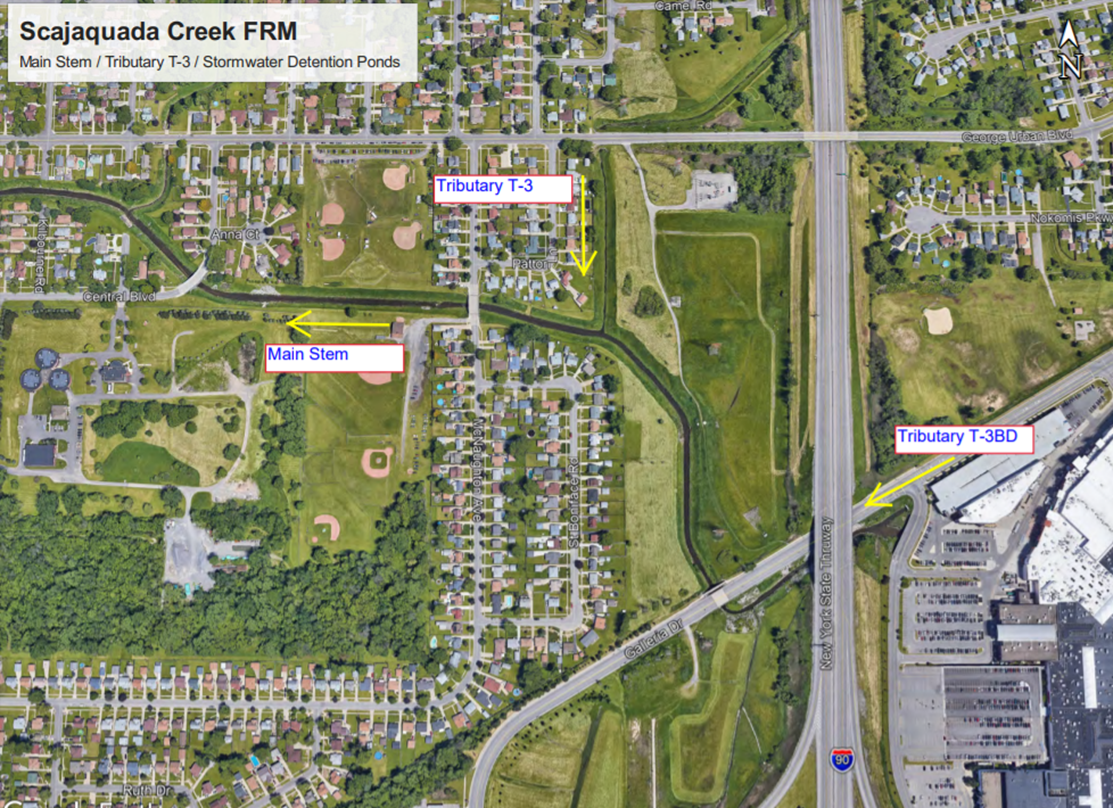

Buffalo Niagara Waterkeeper (BNW) is the non-federal sponsor of a U.S. Army Corps of Engineers (USACE) Feasibility Study project that aims to identify ecosystem restorations within the Scajaquada Creek watershed. These restorations would enhance or offset the footprint of a historic federal Flood Risk Management project in the Town of Cheektowaga.
Final Report & Comments
A draft final report has been released for this project. Click here to view or download a copy of the report. If you would like to provide feedback on the study, please send comments to: scajaquada1135@usace.army.mil
Public Meetings
There have been two public meetings to share details of the feasibility study. One took place in August 2024 and another in December 2025. View news stories from the meetings below.
December 2025 Channel 2/WGRZ Story
December 2025 Channel 4/WIVB Story
August 2024 Channel 4/WIVB Story
Background
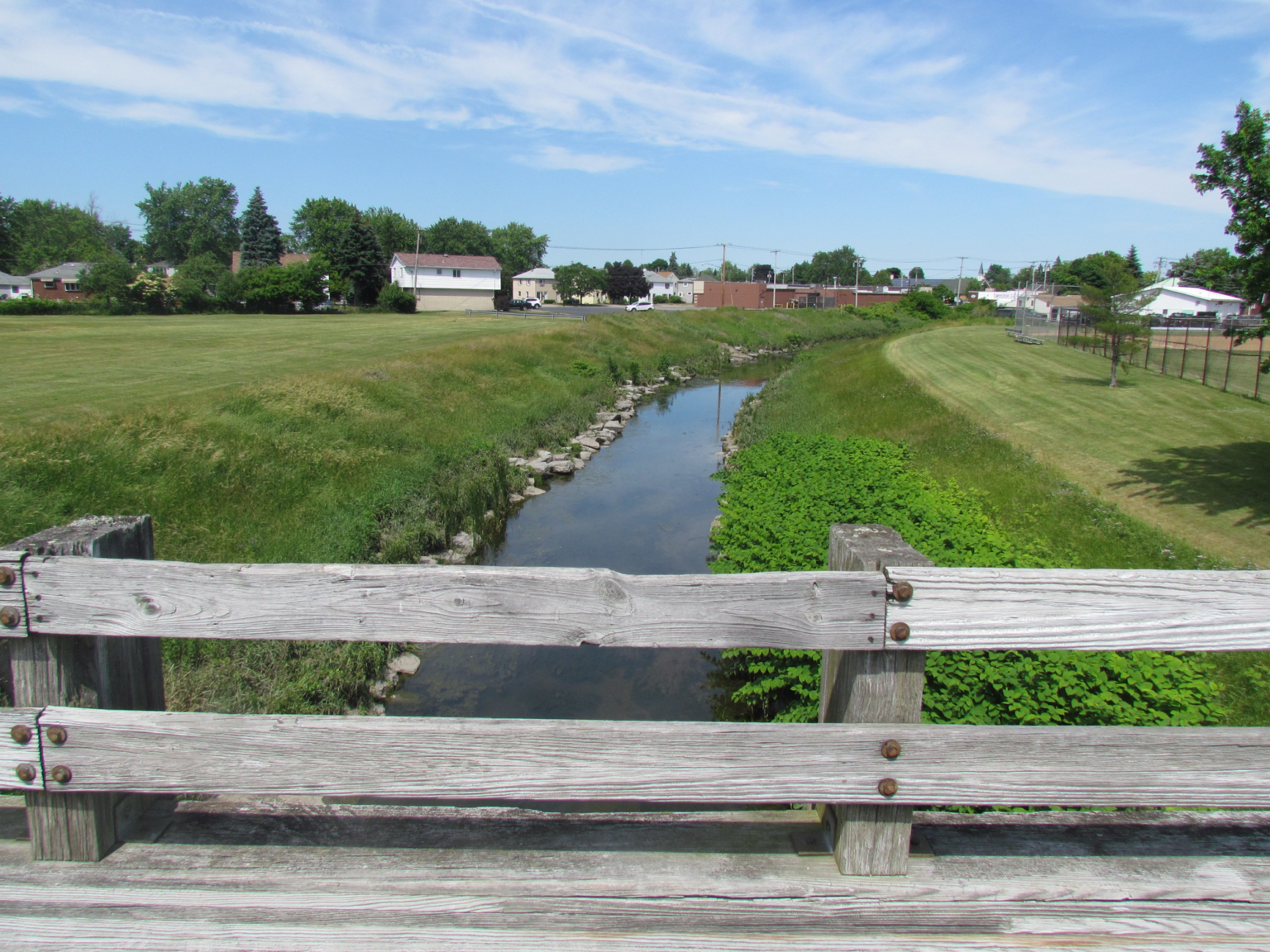
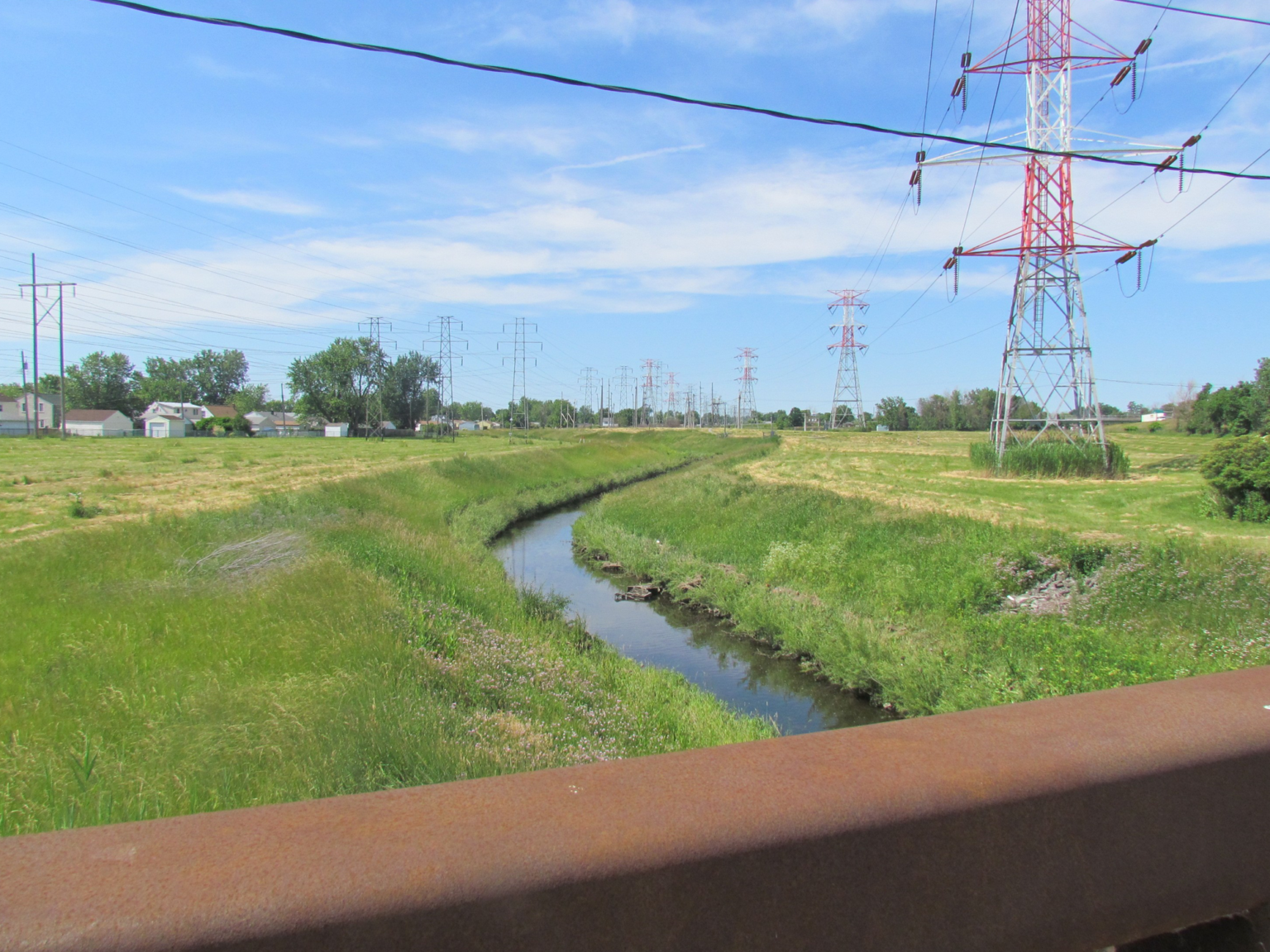
Scajaquada Creek runs through a highly developed part of Erie County, including the Town of Cheektowaga. Over many decades, the creek has been heavily altered. Sections were straightened, widened, armored with concrete, and in some areas placed underground.
These changes were mainly made to help control flooding, especially during the USACE Flood Risk Management Project completed in 1981. The project completed heavy channelization of Scajaquada Creek throughout the Town of Cheektowaga. While this project reduced flood risk, it also caused long-term environmental harm. Natural streambanks were removed, wetlands were lost, and habitat for fish and wildlife declined.
Under the authority provided by Section 1135 of the Water Resources Development Act of 1986, the USACE may plan, design and build modifications to existing USACE projects, or areas degraded by USACE projects, to restore and enhance habitats for fish and wildlife. The 1135 project funds are functionally to be used to offset previous ecosystem degradations attributed in part to USACE Flood Retention Measures (FRM).
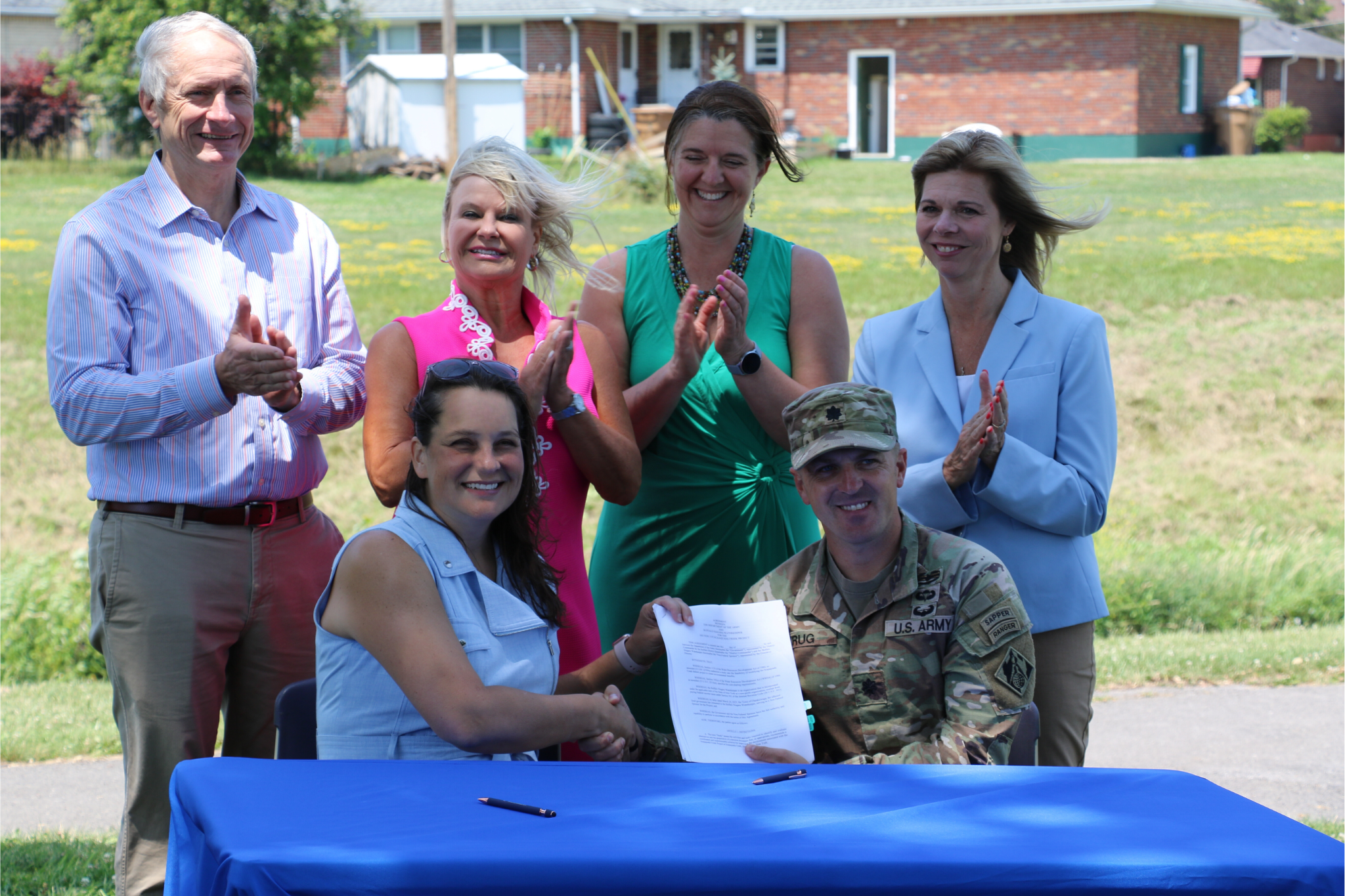
To execute the 1135 Authority, the USACE needs to secure a local sponsor that can provide matching, non-federal cost share. BNW and USACE signed the Federal Cost Share Agreement at a press event/signing ceremony on July 11, 2023. The Town of Cheektowaga and NYS Department of Environmental Conservation (DEC) were key partners throughout the study.
Suitable 1135 projects may be located anywhere within the Scajaquada Creek Watershed, but the Town of Cheektowaga is the priority area. The USACE anticipates approximately $10 million in federal contributions may be available to complete these restorations. To “unlock” funding for implementation, an initial feasibility study phase will need to be completed, resulting in a report with analysis of a full suite of restoration alternatives and associated costs.
Within Western New York, the USACE, BNW, and our partners are looking to use the 1135 program to provide ecosystem restorations that enhance or offset the footprint of the FRM project located in the Town of Cheektowaga, originally constructed to address flooding along Scajaquada Creek.
The Feasibility Study typically takes 18-24 months. The process began in Fall 2023 and is anticipated to be complete in Fall 2025. Following the feasibility study, USACE would need to identify another sponsor for the detailed design and implementation stage via a Project Partner Agreement. The cost-share for the design portion of the effort is 65/35. The USACE is able to conduct construction under this authority.
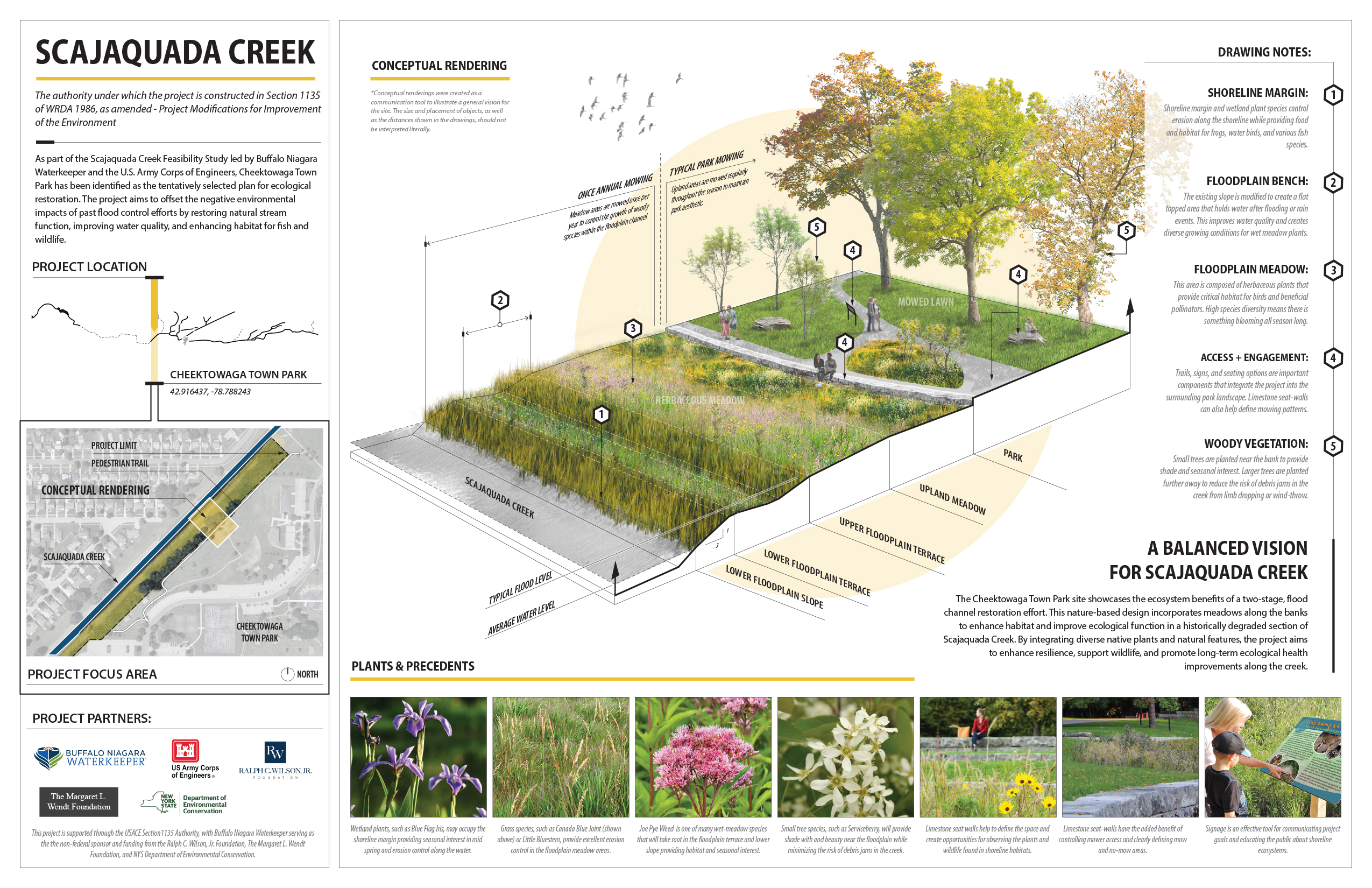
Selected Project: Cheektowaga Town Park Restoration
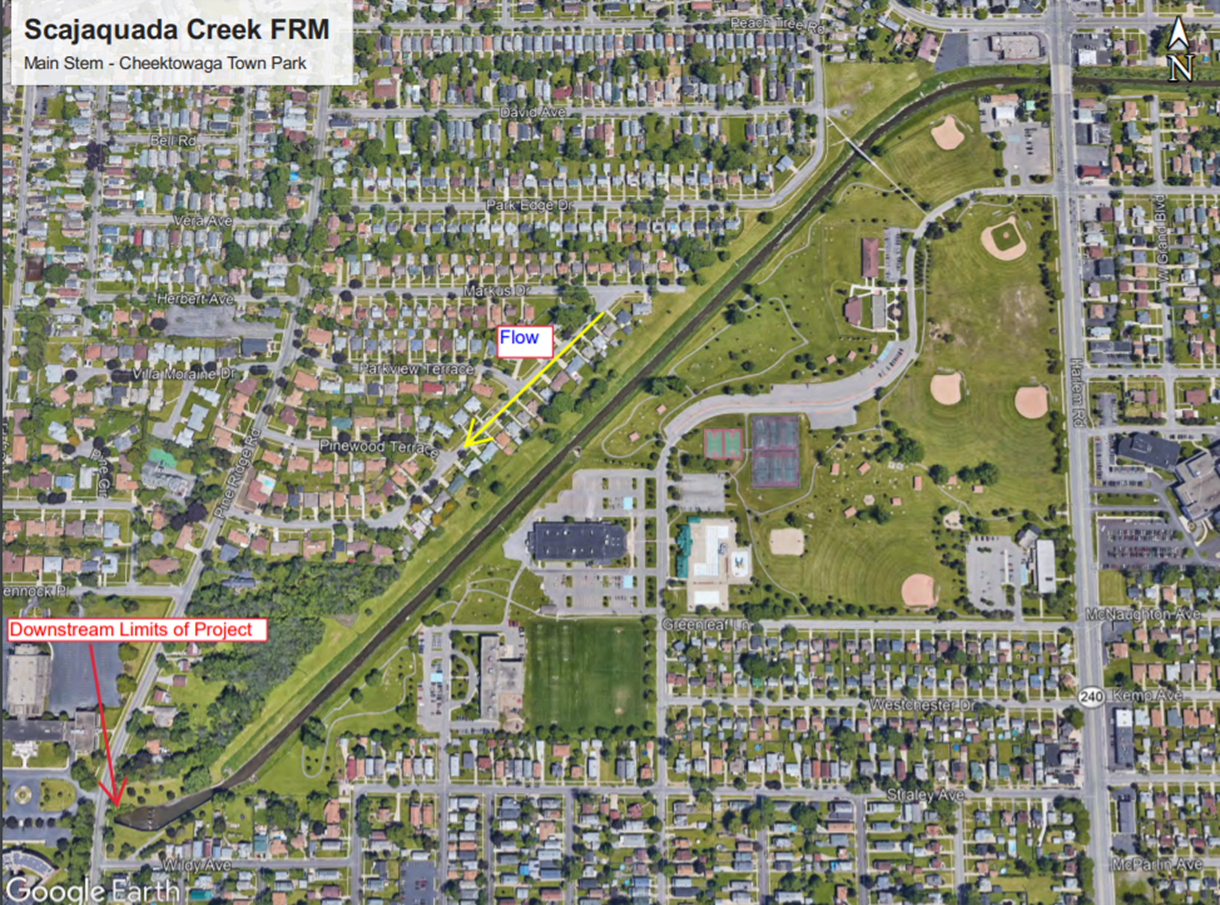
The recommended project focuses on restoring a long stretch of Scajaquada Creek within Cheektowaga Town Park, where the greatest ecological improvement is possible.
The plan includes building a two-stage channel, which adds a lower floodplain bench to help stabilize the creek, improve water quality, and reconnect the stream to its natural floodplain without reducing flood-carrying capacity.
A 100-foot-wide riparian buffer of native trees and shrubs will be planted to rebuild habitat and improve wildlife connectivity. In total, the project restores 5.32 acres of riparian, wetland, floodplain, and in-stream habitat, supported by invasive species removal and minor trail realignments to maintain recreational access.
The project is estimated to cost $5.1 million, and would be cost-shared 75% federal through the U.S. Army Corps of Engineers / 25% non-federal by the Town of Cheektowaga. Continuation of the project to design and implementation is dependent on the availability of funding and establishment of a Project Partnership Agreement.
If the project is implemented, the Town of Cheektowaga would also handle long-term operation and maintenance.
Why Cheektowaga Town Park Was Chosen
Cheektowaga Town Park was selected because it provides significant environmental benefit, offering the largest and most connected area for habitat restoration, improved stream stability, and long-term ecological resilience.
The alternative is also the most cost-effective, delivering the highest ecological gains relative to its cost, while larger options added expense with limited additional benefit.
The site has strong support from the Town, Waterkeeper, and the community due to its visibility and potential for meaningful environmental improvement.